
Running an integrative practice usually means balancing clinical needs with commercial realities. You want to focus on guiding patients toward recovery, but if your clinic accepts insurance, your clinical work is only half the equation. The other half is the administrative rigor that keeps your practice viable.
Holistic healthcare including, acupuncture, medical massage, and integrative chiropractic care, faces more scrutiny from insurance payers than most primary care. Insurers love to challenge medical necessity, visit allowances, and audit your documentation looking for procedural technicalities. Struggling with delayed payments, denial rates, or unfinished medical charts stacking up? Our core best practices will help stabilize your cash flow and bolster your practice against audits.
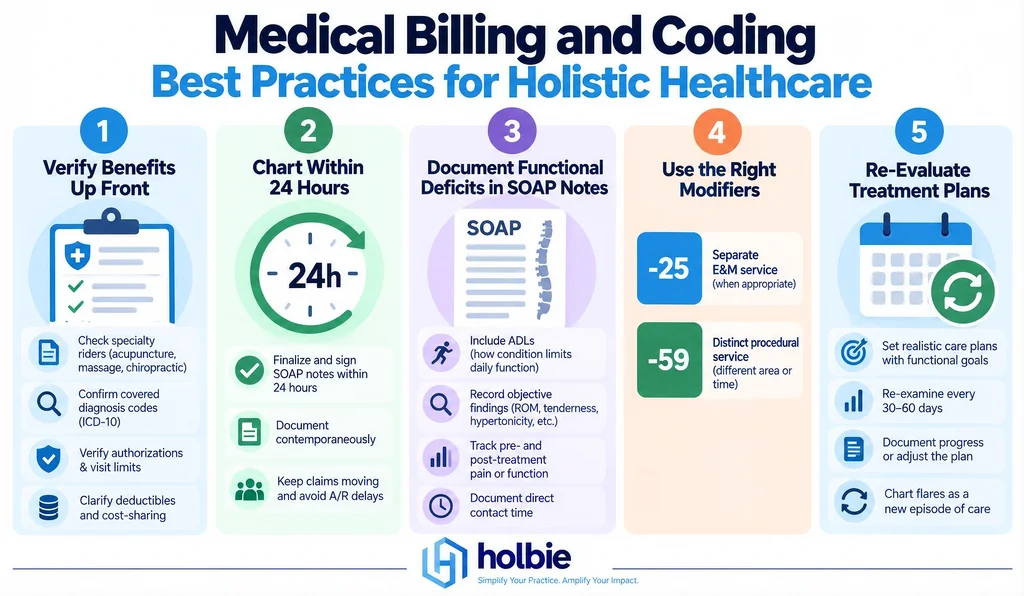
1. Always Conduct Upfront Verification of Benefits (VOB)
We feel that many common denials are preventable before the patient ever steps into your treatment room. Relying on an insurance card or a superficial web portal check that says "active" is the fastest way to render care you will never collect on.
In the holistic health world, coverage is largely defined by exclusions and riders in the patient’s coverage:
Check for Specialty Benefit Riders:
Many commercial policies cover physical medicine but exclude acupuncture or massage therapy outright unless an employer group has purchased a specific supplemental rider. This wrinkle confuses many patients and providers alike.
Identify Covered Diagnosis Categories:
Major insurance companies often restrict holistic coverage to narrow ICD-10 sets, such as chronic low back pain or, less commonly, chemotherapy-induced nausea, while denying claims for headaches, stress, or upper extremity conditions, so get familiar early with the likely covered diagnoses.
Track Authorization & Visit Limits:
Veterans Affairs (VA CCN) and Workers' Compensation require pre-authorization numbers on every single line item. For commercial payers, you must identify whether the patient has an annual calendar-year visit cap (e.g., 12 or 20 visits) shared with physical therapy or chiropractic benefits.
Clarify Deductibles and Cost-Sharing:
Know up front whether patient-due balances like the deductible apply to office procedures, so your front desk staff collect copays or coinsurance at check-in rather than chasing patient balances months later. Your likelihood of collecting these monies is drastically reduced the second the patient walks out the door.
2. Lock In the 24-Hour Charting Rule
One of the most dangerous habits we notice with providers is "batch charting", like waiting until Friday afternoon or Sunday evening to write notes for dozens of past patients.
Insurance companies and state licensing boards will view timely charting as a baseline requirement. During an audit, notes signed days or weeks after the date of service will raise immediate red flags about accuracy and clinical integrity.
- Sign Notes Within 24 Hours: Make it an unbreakable clinic standard that all SOAP notes must be finalized and electronically signed within 24 hours of the encounter.
- Document Contemporaneously: If a claim is pulled for a Targeted Probe and Educate (TPE) review or routine records request, electronic signatures with date and time stamps prove the care was documented while fresh in the provider's mind.
- Avoid Claim Delays: Billing teams cannot scrub, code, or submit claims until the provider signs off on the medical record. Stale charting directly extends your accounts receivable (A/R) cycle.
3. Build audit-tested SOAP Notes Grounded in Functional Deficits
When an insurance auditor sees phrases like "patient feels better" or "received treatment with good tolerance" they consider the note to carry zero clinical weight. It is important to always remember that insurance companies will reimburse you only for functional improvement, not symptom management or relaxation.
Every clinical note must connect the treatment provided to clear, quantifiable baselines that a third-party reviewer can understand:
- Activities of Daily Living (ADLs): Document explicitly how the patient’s condition limits their daily function,such as sitting at a desk for more than 20 minutes, bending to tie shoes, lifting groceries, or sleep disruption.
- Objective Tissue & Joint Findings: Remember to record physical exam markers with clear lateralization (Right, Left, Midline), such as hypertonic muscle groups, localized trigger points/tenderness, restricted range of motion, etc.
- Pre- and Post-Treatment Baselines: Whenever possible, track pain scores or functional ease immediately before and after the session. Make sure to document these on your notes.
- Separation of Contact Time: Physical medicine and acupuncture codes are strictly timed. You must document direct, face-to-face active contact time.
4. Pay Attention to Modifiers
Wrong modifiers will lead to automatic rejections in physical and holistic medicine.
- Modifier -25 (Significant, Separately Identifiable E&M): Only bill an Evaluation & Management code (99202–99214) alongside procedural codes if you performed a distinct, documented examination. Routine pre-treatment greetings, tongue/pulse checks, and minor check-ins are already bundled into procedure codes (like 97810 or 97140). It’s important to save modifier -25 for new patient visits, new secondary complaints, or formal 30-to-60-day re-examinations where E&M time is tracked separately from procedure time.
- Modifier -59 (Distinct Procedural Service): When billing multiple physical medicine modalities on the same date (such as acupuncture alongside manual therapy or therapeutic exercise), Modifier -59 indicates the services were performed in distinct anatomical regions or during completely separate timed intervals.
5. Re-Evaluate Treatment Plans Every 30 to 60 Days
Most insurance will not cover open-ended wellness maintenance care. If your chart reflects months of treatment with the same patient complaints, frequencies, and techniques without documented progress or plan adjustments, you can plan on your claims eventually being denied as non-medically necessary.
- Establish Realistic Care Plans: Define your treatment frequencies upfront (e.g., 2x weekly for 4 weeks) tied to specific functional targets for the patient.
- Conduct Formal Re-Examinations: Every 30 to 60 days, re-administer outcome measures to demonstrate tangible progress toward discharge or transition to a home exercise program.
- Document Flares Separately: When one of your chronic patient experiences an acute exacerbation, it is important and proper to chart it as a distinct episode of care with renewed clinical reasoning.
How Holbie Protects Your Revenue and Daily Workflow
Following these billing best practices shouldn't require hours buried in paperwork or hiring multiple expensive administrators.
At Holbie, we built our software and billing infrastructure specifically to automate these operational standards for acupuncture, massage therapy, and integrative clinics:
- Complete Upfront Benefit Verifications: We attempt to verify patient eligibility, deductible statuses, specialty riders, and pre-authorizations before treatment begins, minimizing the risk of performing uncollectible work.
- Audit-tested SOAP Charting in Seconds: Our fast, compliant SOAP templates allow you to log objective physical findings, ADL limitations, pre/post pain scores, and direct contact minutes in seconds, making the 24-hour charting rule effortless to maintain.
- Integrated Clinic Management ($25–$50/mo): Eliminate fragmented systems by bundling online scheduling, automated text reminders, digital intake, and POS credit card processing into one platform.
- Dedicated Denial Resolution: We scrub claims upfront against payer-specific holistic billing rules to keep denials low. When an insurer does push back, our dedicated internal denial recovery team tracks down the claim, corrects the issue, and files the appeal on your behalf.
Want to tighten your billing practices, reduce denials, and lower your administrative overhead?
Connect with the Holbie team today to schedule an operational workflow review.