
Nobody goes into acupuncture dreaming of spending a sunny Thursday afternoon squinting at a confusing Explanation of Benefits (EOB), wondering why a $140 claim suddenly paid $46.12.
Most of us got into this field to help people get out of pain, restore balance, and run a respectable clinic. Then insurance enters the picture, and suddenly we feel like we need a minor in forensic accounting just to figure out what an insurer considers a fair day's work.
You set your billed rate, treat the patient, document everything with care, and send off the claim. A month later, the check clears, and the math looks like it came from a Magic 8-Ball.
We’ve lived in the trenches of holistic billing long enough to see every bizarre trick payers pull. While insurance companies love making fee schedules feel like proprietary state secrets, commercial allowables do follow a rhyme and reason, and once you see it, it's easier to spot where your hard-earned revenue gets quietly chopped along the way.
Billed Charges vs. Payers’ Allowable Amounts
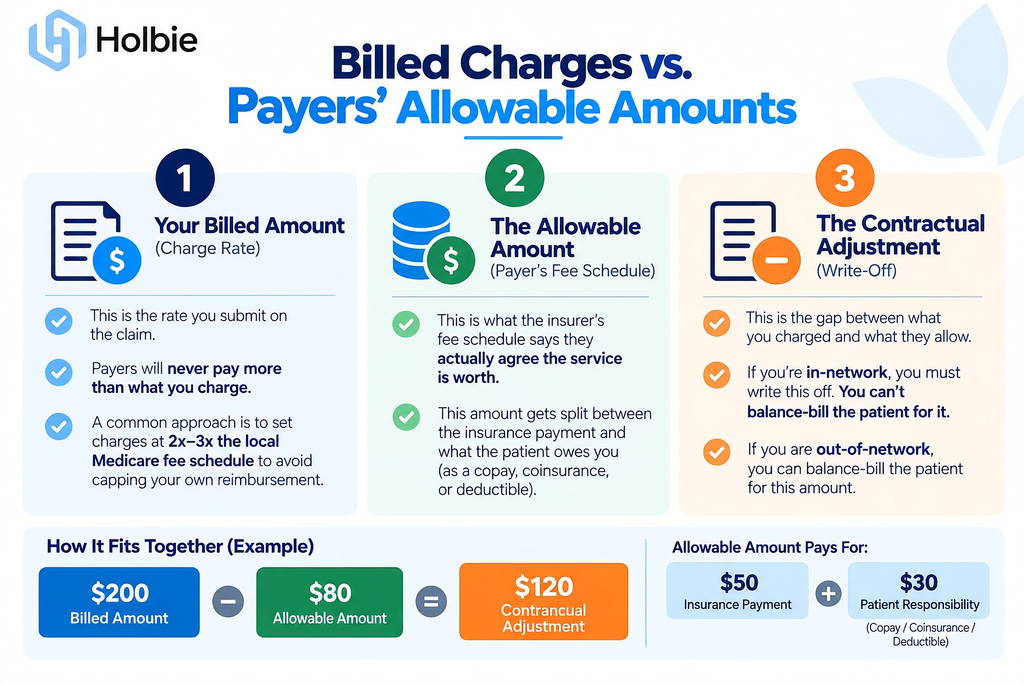
First, here’s a primer so you don't drive yourself crazy comparing figures:
- Your Billed Amount: This is the rate you submit on the claim. Payers will never pay you more than what you charge, and you can only set one rate, so your billed amount should be above the highest likely contracted rate in your area. A common rule of thumb among clinics is to anchor this number to a common source, like setting your charges at 2x to 3x the local Medicare fee schedule; the idea is to avoid accidentally capping your own reimbursement.
- The Allowable Amount: What the insurer’s fee schedule says they actually agree the service is worth. This gets split between their direct deposit and what the patient owes you as a copay, coinsurance, or deductible.
- The Contractual Adjustment: The gap between what you charged and what they allow. If you’re in-network, you have to write this off and take the haircut. You can't balance-bill the patient for it, no matter how much you might want to. If you are out-of-network, you can usually balance-bill the patient, subject to your state’s rules.
The State-by-State Reality: What Commercial Payers Actually Hand Over
Unfortunately, reimbursements aren't uniform. You can perform the same treatment, like an initial needle set plus an additional set, and receive wildly different checks depending on which side of a state border your clinic sits.
Here is how the real-world commercial insurance landscape looks across the major markets we monitor (for plan-by-plan coverage rules, see which insurance companies cover acupuncture):
1. California: High Demand, Tightly Managed
- Typical In-Network Range (Standard Multi-Set Visit) is in the $70 – $95 range.
- The Reality: California is full of patients eager for holistic care, but commercial carriers are actively outsourcing their networks to third-party benefit managers. That often means more capped per-visit rates or bundled reimbursements than in other major markets.
2. New York: Stronger Baselines & Very Active Out-of-Network
- Typical In-Network Range (Standard Multi-Set Visit) is $85 – $125, where Out-of-Network is closer to $140 – $180+
- The Reality: New York payers generally offer higher contracted baselines, and there is a healthy out-of-network market. You should be actively pursuing employers whose employees have out-of-network benefits.
3. Florida: Commercial Struggles vs. Auto PIP Payouts
- Typical Range (Standard Multi-Set Visit): $65 – $90 (Commercial) | $95 – $130 (Auto PIP / Workers' Comp).
- The Reality: We’re seeing the commercial plans get stingier, but Florida’s Personal Injury Protection (PIP) and Workers' Comp statutes provide solid reimbursements, as long as your clinical documentation clearly proves the injury's impact on daily function.
4. Michigan & The Rest of the Midwest: Steady… but Guarded
- Typical In-Network Range (Standard Multi-Set Visit): $75 – $105.
- The Reality: In the Midwest, allowable rates are decent and usually predictable, but most major regional carriers are keeping a tight leash on visit caps, and we’re seeing them demand clear medical necessity before releasing funds.
Why Your Claims Get Slashed (aka "The Silent Haircut")
When speaking to new clients, we notice that when a check comes back lower than expected, most practitioners will assume their contracted rate is just bad. But in our experience, the payer usually just dropped half your claim through automated edits.
Here are the three most common ways claims are getting stripped this year by carriers:
1. Dropping the Secondary Needle Set
You spend 30 minutes in direct contact, place two distinct needle sets, and bill accordingly. The payer pays the first set and completely denies or bundles the second. If your clinical note doesn't clearly separate direct hands-on time from the time the patient spent resting on the table, their automated claims system simply deletes the add-on.
2. Botched Modifiers (If You Do Your Own Coding)
We don't select diagnosis or procedure billing codes for clinics; that's always up to you as the treating provider. But if you handle your own coding and billing, you need to get very comfortable with billing modifiers.
Specifically, familiarize yourself with modifiers like 25 and 59. (For a deeper look at modifier 25, see our guide on whether acupuncturists can bill office visits.)
- If you perform a distinct initial exam or formal re-evaluation alongside treatment, or two separate procedures during the same visit, failing to append the appropriate modifier tells the payer's computer: "Please bundle these together and only pay me for one."
- On the flip side, slapping them on every visit without distinct documentation invites an audit clawback. If you are doing your own billing, please do your homework on how and when to use them.
3. Diagnostic Mismatches and Silent Downcoding
Commercial claims engines are ruthlessly literal when it comes to reimbursing you. If an ICD-10 diagnosis code you choose doesn't exactly match the carrier's documented coverage policy for acupuncture, they may not deny it outright. Still, they may remap your visit to a lower allowable tier.
How Does Holbie Help You Navigate the Maze of Fees?
We built Holbie because we got tired of watching great practitioners burn out on billing software and processes that felt like they were built in 1998. We don’t pretend billing is magical, but we make sure you aren't leaving money on the table and help you process claims in a logical, straightforward way.
- Audit-Tested Time Tracking: Payers love denying multi-unit treatments because the notes are sloppy. Holbie’s SOAP notes give you dedicated fields to log active contact minutes, creating clean records that help stand up to review.
- Specialized Claim Scrubbing: Because our platform has processed hundreds of thousands of holistic claims across key states like California, New York, and Florida for years, our rules engine catches specialty-specific discrepancies and missing data before they are ever transmitted.
- We Fight the Denials for You: If an insurance company underpays an allowable rate or arbitrarily denies an earned service, you shouldn’t have to waste your lunch break listening to automated payer hold music. Holbie’s dedicated denial resolution team tracks down the claim, sorts through the remittance, and handles the appeals directly.
- Practice Software That Doesn't Gouge You: Why hand over $100+ a month to software companies that charge extra for basic scheduling, SMS reminders, and digital intake? Holbie bundles scheduling, intake, and charting into one simple, low-cost platform. See what you could save with our practice software savings calculator.
Know Your Numbers, Keep Your Revenue
Insurance companies count on independent practitioners being too busy or exhausted to question an underpaid claim.
When you know your market's real allowable rates, take time to understand the coding rules that apply to your care, and keep your documentation tight, you stop taking arbitrary pay cuts and start building a stable, predictable practice.
Want to see how in-network rates compare with cash pay once patient retention is factored in? Try our free acupuncture practice revenue calculator.
Curious how your current reimbursements stack up or where your clinic might be leaking cash? Book an operational revenue review with the Holbie team today.