
If you bill insurance at your practice, you already know submitting claims isn't as simple as emailing an invoice to Blue Cross or Aetna.
Between your clinic’s practice management software and the payer’s claims adjudicator sits an essential middleman: the medical billing clearinghouse.
Understanding what a clearinghouse does and why claims get stopped there, is the difference between getting paid on a clean 14-day cycle and wondering why your accounts receivable is drifting past 60 days.
What Does a Medical Billing Clearinghouse Actually Do?
Think of a clearinghouse like the postal sorting hub and customs checkpoint combined.
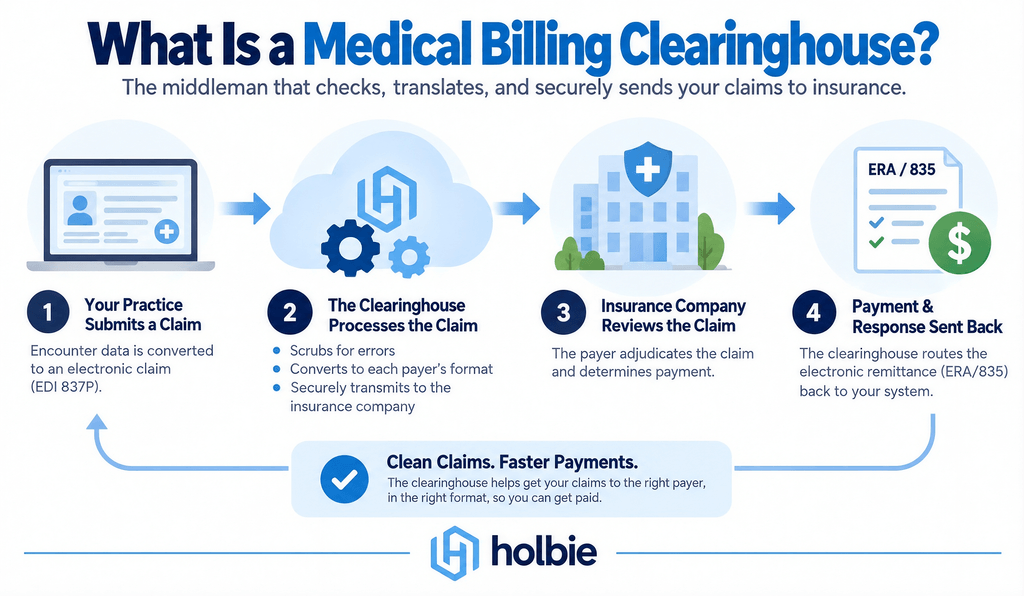
When you finalize a patient encounter, your software bundles your diagnosis codes (ICD-10), procedure codes (CPT), patient demographics, and rendering provider details into an electronic CMS-1500 format.
The clearinghouse converts that raw data fted into an industry-standard format known as an EDI 837P transaction (Electronic Data Interchange for Professional Claims).
Your clearinghouse intercepts that file and performs three critical jobs:
Claim Scrubbing:
Before the payer ever sees your claim, the clearinghouse scans it against thousands of automated billing rules. It will check for missing subscriber IDs, incorrect NPI/taxonomy combinations, expired insurance group numbers, and formatting errors in dates of birth.
Secure Transmission
Once the claim passes the scrub, the clearinghouse translates the file into each specific payer’s proprietary electronic format and securely transmits it to the insurance carrier.
Electronic Remittance Routing (ERA/835):
When the payer adjudicates the claim, they will send back an electronic payment voucher (the ERA, or 835 file). The clearinghouse routes this back to the practice management system so you can see what was paid, adjusted, or applied to a deductible.
Clearinghouse Rejection vs. Insurance Denial: Don't Confuse the Two
One of the biggest misunderstandings in clinic billing is treating every unpaid claim as an "insurance denial."
A Clearinghouse Rejection:
Never reached the insurance company. The clearinghouse caught a formatting error, a typo in the member ID, or an invalid NPI and kicked the claim back to you immediately. The payer has no record of it. This does not count against your timely filing limit, but until you fix the administrative typo, the clock is ticking.
An Insurance Denial:
The claim made it through the clearinghouse, arrived at the payer for processing, but adjudication engine officially rejected payment due to clinical or a policy rules like a missing pre-authorization, exceeding daily unit limits, non-covered services, or an unsupported modifier.
Catching errors at the clearinghouse stage is a good thing; it saves you from waiting 30 to 45 days to learn an insurance company rejected a claim for a transposed digit.
Comparison of Major Medical Billing Clearinghouses
Most independent providers don't choose their clearinghouse in a vacuum. It is usually integrated into their EHR, practice management system, or billing service. However, knowing the major players helps you understand how your claims move:
| Clearinghouse | Primary Focus | Pros | Cons |
| Change Healthcare / Optum | Enterprise & Broad Payer Connectivity | Massive payer network; handles a huge percentage of all US commercial claims. | Slower customer support for small practices; major target for cybersecurity vulnerabilities. |
| Availity | Commercial Payer Integration | Official gateway for Anthem/BCBS and many large national payers; robust free basic portal options. | Portal interface can be clunky; payer-specific rules vary wildly across regional plans. |
| Waystar | Independent & Mid-Sized Practices | Exceptional claim scrubbing tools; clean user dashboard; solid denial analytics. | Higher per-provider subscription costs; can be expensive for solo practitioners. |
| Office Ally | Solo Providers & Small Clinics | Historically very low-cost entry point; allows manual direct-data entry of CMS-1500s. | Outdated user interface; customer support is slow; fees have increased for non-participating payers. |
| Trizetto Provider Solutions | Multi-Specialty & Billing Services | Deep integration with major EHRs; powerful rules engine for custom edits. | Primarily designed for larger billing entities; complex setup and contract minimums. |
Where Independent & Holistic Clinics Run Into Trouble
Here is the problem: generic clearinghouses are built for general medicine. They check if the patient's name matches their policy card and whether your NPI is valid.
What they don't know are the specialized nuances of physical medicine and holistic care:
- They don't know that billing manual acupuncture (97810) and electroacupuncture (97813) on the same date will trigger an unbundling denial.
- They don't flag that your massage therapy claim (97124) lacks a separate anatomical region when billed alongside chiropractic manual therapy (97140).
- They won't warn you if you failed to append Modifier -25 to an E&M code.
When specialized claims slip through a generic clearinghouse with basic formatting approval, they can still hit a formal insurance denial on the payer side.
How We Handle Clearinghouse Workflows at Holbie
At Holbie, our providers don't have to manage clearinghouse contracts, pay separate connection fees, or decode raw EDI rejection reports.
We build clearinghouse connectivity directly into our platform:
- Specialty-Specific Pre-Scrubbing: Because we've spent over a decade handling holistic billing for acupuncture, chiropractic and massage-based practices, our platform scrubs claims against historical payer rules across acupuncture, massage therapy, and chiropractic care before they ever transmit.
- Unified Technology ($25–$50/mo): Instead of paying for a separate EHR, a separate scheduling tool, patient reminders and a third-party clearinghouse monthly, Holbie bundles online scheduling, SOAP charting, and billing integration into one simple platform.
- Dedicated Denial Resolution: If a claim passes the clearinghouse but gets held up by an insurance company, you don’t have to pick up the phone. Our full-time denial recovery department reviews the chart, corrects the submission, and fights the appeal for you.
Tired of chasing clearinghouse rejections and unpaid claims? Book a quick revenue workflow review with Holbie today.