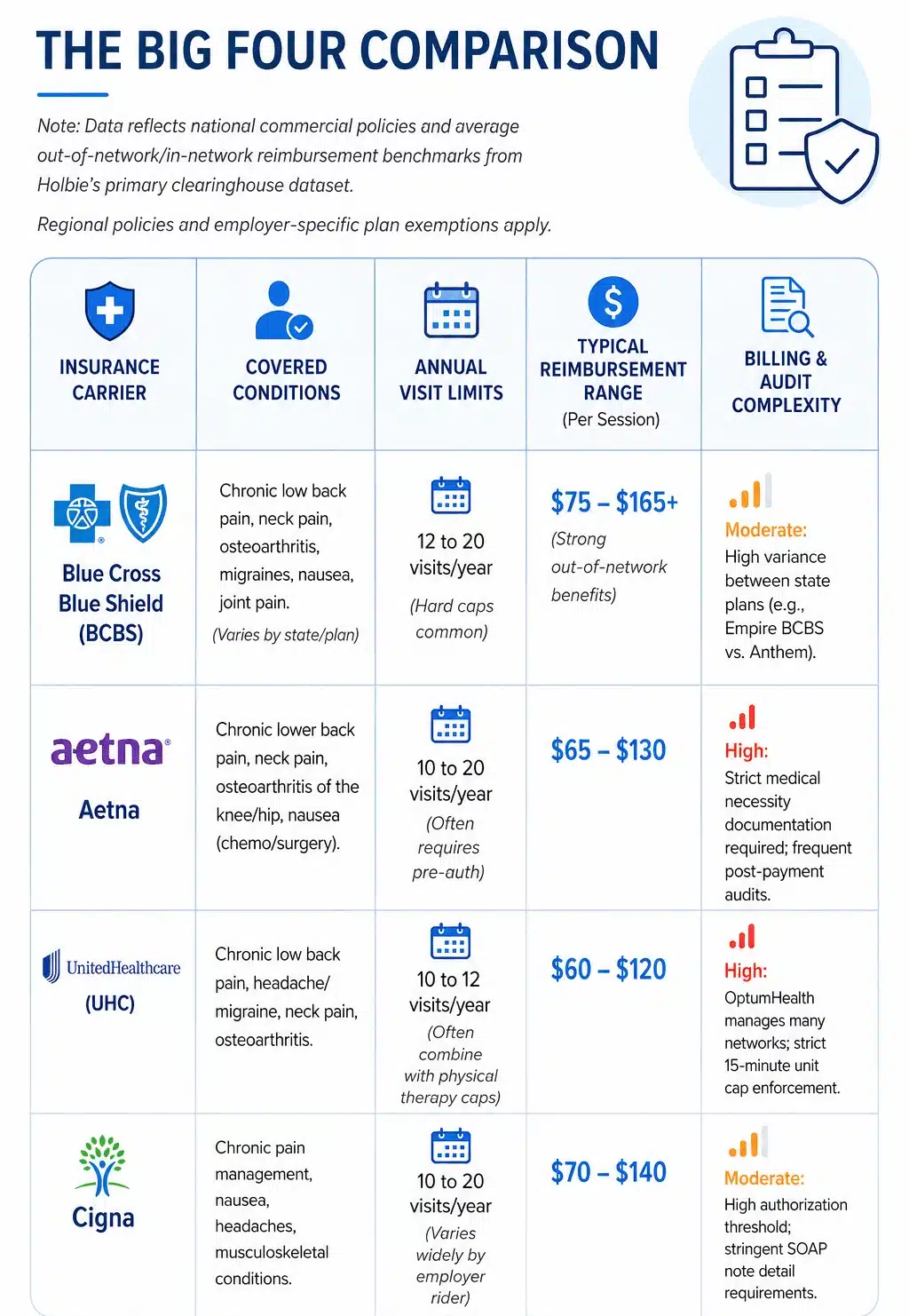
Today I want to talk to you about the nitty-gritty of acupuncture billing. When acupuncture claims are denied or downcoded, the issue rarely stems from medical necessity. In most cases, claims fail due to structural coding mismatches, specifically unclear direct contact time with needle retention, misuse of initial codes, or incorrect modifier attachment.
Because your acupuncture codes are timed physical medicine services built around 15-minute increments of personal face-to-face contact, insurance payers will run scrub rules on every submitted line item.
Below is a simple breakdown of how to structure initial vs. subsequent units for manual and electroacupuncture, apply proper modifiers, and document sessions to protect your practice.
1. The Core 4 Code Structure: Manual vs. Electrical Stimulation
Acupuncture billing operates on a four-tier primary structure divided strictly by two factors: modality (manual vs. electrical stimulation) and order of service (initial unit vs. add-on unit).
| CPT Code | Description | Modality | Service Type | MUE (Daily Limit) |
|---|---|---|---|---|
| 97810 | Acupuncture, 1 or more needles; without electrical stimulation, initial 15 minutes of personal one-on-one contact | Manual | Initial | 1 Unit |
| +97811 | Each additional 15 minutes of personal one-on-one contact, with re-insertion | Manual | Add-on | Usually 2–3 Units |
| 97813 | Acupuncture, 1 or more needles; with electrical stimulation, initial 15 minutes of personal one-on-one contact | E-Stim | Initial | 1 Unit |
| +97814 | Each additional 15 minutes of personal one-on-one contact, with re-insertion | E-Stim | Add-on | Usually 2–3 Units |
(Note: Add-on codes marked with + cannot stand alone on a claim form; they must be linked to a primary base code.)
2. Choosing Between 97810 and 97813: The "Single Initial Code" Rule
A common reason for claim rejections occurs when a provider performs both manual needle work and electroacupuncture during the same visit and attempts to bill both 97810 and 97813.
The Rule: You can bill only one initial acupuncture code per patient per date of service.
- If you only perform manual acupuncture, bill 97810 as your base code and bill 97811 for subsequent timed blocks.
- If you only perform electroacupuncture: Bill 97813 as your base code, and bill 97814 for subsequent timed blocks.
- If you perform a hybrid session (Manual + E-Stim):
- If electrical stimulation was utilized during the initial segment of treatment, lead with 97813.
- If you started with manual acupuncture and added electroacupuncture in a secondary 15-minute increment, bill 97810 as the initial unit and report the second increment using the electroacupuncture add-on code +97814.
Want the entire decision path on a single page? Grab our visual cheat sheet and keep it by your billing desk:
3. Modifiers: When to Use Modifier -25 vs. Modifier -59
Payers utilize National Correct Coding Initiative (NCCI) edits to prevent unbundled billing. Attaching the wrong modifier—or applying one when it isn't justified—triggers immediate automated denials.
When to Use Modifier -25 (Separate E&M Service)
CPT codes 97810–97814 already include standard pre- and post-service evaluation (greeting the patient, briefly asking how they feel, checking pulses, and charting).
Do not bill an Evaluation & Management code (99212–99214) with every routine visit. You may only bill an E&M code alongside acupuncture by attaching Modifier -25 when:
- It is a new patient evaluation (99202–99204).
- The patient presents with a new complaint, a significant exacerbation of symptoms, or undergoes a mandatory periodic formal re-examination (e.g., every 30–60 days to update treatment plans).
- The chart note clearly separates the history/exam decision-making from the physical treatment notes.
When to Use Modifier -59 (Distinct Procedural Service)
Attach Modifier -59 (or the appropriate X{EPSU} modifier where required) when performing an adjunct physical medicine service on the same date as acupuncture, such as:
- Manual Therapy (97140)
- Therapeutic Exercise (97110)
- Cupping / Mechanical Traction (97016)
Billing Tip: The documentation must show that the manual therapy or exercise was performed in a separate anatomical region or at a distinctly separate time interval from the needle insertion.
4. Clean Documentation Checklist for Audit Defense
If an insurance auditor requests medical records for a date of service, your chart note should contain these specific elements:
- ✅ Exact Time Tracking: Clear recording of start/stop times or total face-to-face active contact minutes (separate from retention time).
- ✅ Anatomical Point Specificity: Names or locations of points used (e.g., LI4, ST36, Ashi points, Bilateral GB34).
- ✅ Stimulation Parameters (for 97813 / 97814): Documented frequency, intensity, duration, and paired channels if electrical stimulation was applied.
- ✅ Re-insertion Details (for 97811 / 97814): Clear notation describing needle removal, repositioning, and secondary re-insertion.
- ✅ Functional Response: How the patient tolerated the procedure and immediate post-treatment assessment.
Streamlining Your Practice Workflow
Navigating complex payer rules, modifier pairing, and timed unit caps shouldn't pull you away from patient care.
At Holbie, our integrated practice management and billing platform was built specifically around the clinical workflows of acupuncture and integrative medicine. By combining compliant SOAP documentation templates, automated scrubbing against payer-specific edits, and specialized billing expertise, we help independent clinics maintain clean claim rates and protect their bottom line.
Looking to review your billing workflows or cut practice overhead? Connect with our team today to schedule a practice revenue review.