This is the second post in our series breaking down how to actually start accepting insurance in your integrative, acupuncture, or massage practice.
Last week, we looked at the real, hard figures from over 150,000+ transactions processed last year. If you missed it, you definitely want to go back and check out that post. There is some incredibly relevant data in there that you can apply to your own clinic's math. Because Holbie provides the leading acupuncture and massage billing services in the country, this data is about as accurate as you can possibly get.
Most of the numbers shared last week were at the national level. But if you’re curious about what the numbers look like for your state specifically or your specialty, just reach out to me. I’d be happy to run a free custom analysis for your area.
The Cold, Hard Truth About Healthcare
For today, let's just assume you've accepted the math: from a purely business standpoint, welcoming insurance patients is the smartest move you can make. Honestly, it’s a cold, hard fact of where American healthcare is at right now, and it’s exactly where the trend is heading for integrative medicine. Good luck finding any other type of medical provider in the U.S. who can survive on cash alone.
But as an acupuncturist or massage therapist, you are actually in a highly unique position. Unlike medical doctors, most of your local peers are still only accepting cash. That means the second you open your doors to insurance, you instantly have a massive competitive advantage for capturing those patients. So, how do you actually start participating with these insurance companies?
Option 1: Going In-Network (The Contracted Route)
When you go to your own primary care doctor or a specialist, they are almost always "in-network." This means they have a signed, legal contract with the insurance company and have agreed to a pre-negotiated rate for their procedures. In the billing world, we call this being "credentialed." If you want to go this route, you can reach out to each insurance company directly. They all have a dedicated area on their websites where you can submit your credentialing documentation. If you decide to tackle this on your own, pack your patience: insurance companies are notorious for taking their sweet time, and the process usually takes at least a few months.
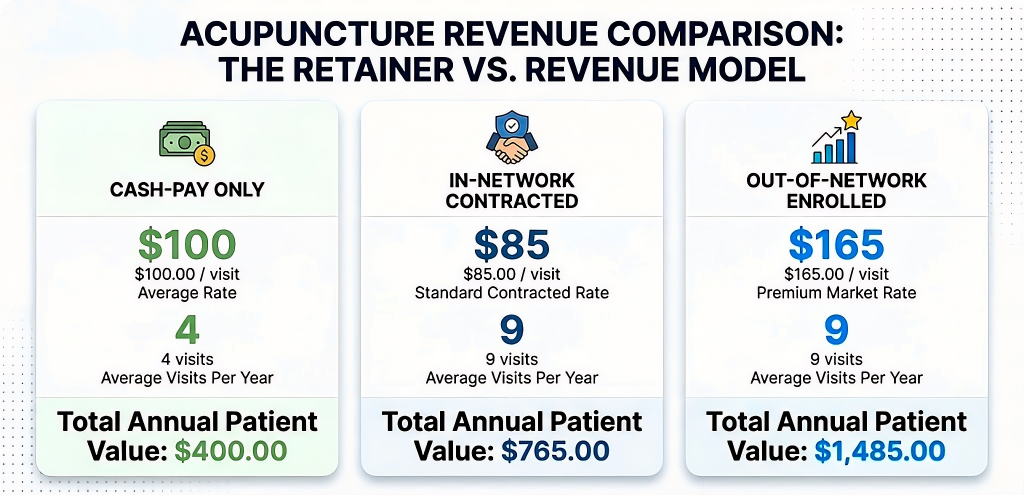
Once you are in-network, your reimbursement rate typically ranges from $60 to $100 per visit, depending on your geographic location. Providers accept this lower rate because of a specific theory: the insurance company's network and website directory will promote your practice and drive a high volume of new patients directly to you. For traditional medical doctors, this bargain works. But in my opinion? For integrative healthcare right now, going strictly in-network means you're taking an unnecessary pay cut. From what we see across the country, most people looking for acupuncture or massage treatments don't automatically think to search their insurance company's provider directory. They look for reviews online or get a recommendation from a friend first. So if you go strictly in-network, you often end up accepting a lower rate cut without actually getting the marketing wave or patient volume you were promised in the bargain.
Option 2: Out-of-Network Benefits (The Sweet Spot)
Now, out-of-network benefits are a completely different thing. Most major insurance plans include out-of-network coverage, but the average person isn't used to using them. Typically, these are built into insurance plans as a safety net, allowing patients to see a specialist for a specific condition when no in-network provider is available. Let’s say you need to see a cardiologist who is only available at the Cleveland Clinic. These benefits are intended to cover that type of situation.
However, when it comes to insurance billing for acupuncturists and massage therapists, these out-of-network benefits are incredibly powerful.
First of all, they are highly lucrative for your practice, usually yielding $120 to $200 per visit. Not only are they paying a much higher rate for your treatments, but it's also significantly easier to participate with the insurance companies this way.
The main difference here is that you are enrolling with the insurance company rather than undergoing full credentialing. Enrollment usually just requires submitting basic demographics and tax forms. Once submitted, you are added to the insurance company's roster of physicians as a sort of affiliated provider rather than a heavily restricted, contracted provider.
By building your strategy around out-of-network benefits, you preserve your higher per-visit revenue while opening your doors to a massive market of insured patients. But to make this work, you have to know where to find these specific patients and how to verify their plans.
What's Next?
Getting set up on the insurance rosters is only half the battle. Next week, we are going to dive into the marketing side of things: how to find these exact high-yield insurance patients and how to position your practice to attract them.
Or… if you don't want to wait until next week to figure out your credentialing or enrollment strategy, let’s talk. At Holbie, we operate as a dedicated acupuncture and massage billing company that handles the entire pipeline for you, from setup to daily claims management so you can focus entirely on your patients.