If you run a community acupuncture clinic, or offer sliding-scale group sessions alongside private rooms, you've probably heard this from a patient sitting in your recliner: "I love coming here every Tuesday. Can I just use my Aetna card to cover this?"
Or maybe you're new to insurance, looking at an open room with six zero-gravity chairs and thinking, "If I can treat four patients an hour in here and get paid by insurance for each one, my practice is set."
At first it looks like a win-win. But if you submit commercial insurance claims for group community acupuncture, you'll likely face claim rejections, repayment demands, and possible audit problems.
In practice, commercial insurance won't pay for community acupuncture. Here's why insurers won't cover group treatments, what the CPT coding rules require, and how to move interested community patients into one-on-one appointments that insurance will reimburse.
The CPT Coding Trap: One-on-One vs. Group
To bill commercial insurance, your service has to match the exact definition of an AMA CPT code. That's where community acupuncture runs into trouble.
1. The Strict Definition of CPT 97810 and 97811
Commercial plans recognize four primary CPT codes for acupuncture:
- 97810: initial 15 minutes of personal one-on-one contact, without electrical stimulation
- 97811: each additional 15 minutes of personal one-on-one contact, without electrical stimulation (add-on code)
- 97813: initial 15 minutes of personal one-on-one contact, with electrical stimulation
- 97814: each additional 15 minutes of personal one-on-one contact, with electrical stimulation (add-on code)
Every one of these codes requires personal one-on-one contact. Under AMA and payer definitions, that means direct, face-to-face clinical time with that individual patient: point selection, skin prep, needle insertion, re-evaluation, or needle removal. Time a patient spends resting in a shared room while you treat others doesn't count.
2. Why "Group Therapy" Codes Don't Work
Providers often ask about using a group code like CPT 97150 (therapeutic procedures, group of two or more). It isn't a workaround:
- Commercial payers generally define 97150 as active physical therapy exercise or neuromuscular re-education, not passive needle retention.
- Many commercial fee schedules don't allow licensed acupuncturists (LAcs) to bill 97150 at all.
- Even where a group code is accepted, reimbursement is usually far lower than standard 97810/97811 billing, or nothing.
The Privacy and Documentation Problem (HIPAA & Medical Necessity)
Beyond the time rules, insurance claims need medical records that hold up in an audit. Group settings create two big problems:
- Clinical intake in a shared room: a SOAP note that stands up to payer review includes the chief complaint, pain score, range-of-motion limits, and a diagnosis. Collecting that in an open room where other patients can hear raises real privacy concerns.
- Functional treatment plans: insurers pay for acupuncture that treats a specific functional problem, like low back pain or post-op nausea, and only when the notes show measurable improvement over roughly 6–12 weeks. Community acupuncture usually focuses on wellness and maintenance, which tends to get denied as not medically necessary.
How to Transition Community Patients to Reimbursable Private Visits
Community acupuncture is a great, low-pressure way for new patients to try your clinic and see how acupuncture works without worrying about cost.
So when a community patient asks about insurance, don't just say "No, insurance doesn't cover that." Use it as a chance to book a full private assessment that may qualify for coverage. Here's a simple three-step plan.
Step 1: Explain the Difference in Plain English
Give your front desk a short script like this:
"Our community room is an open, affordable shared space, but insurers don't let us bill for group sessions. Your plan might cover private one-on-one care, which includes a full medical intake, hands-on work, electro-acupuncture, and a custom treatment plan. If you're interested, our front desk can check your benefits and tell you what a private session would cost."
Step 2: Run a Thorough Verification of Benefits (VOB)
Before booking a private session, check their benefits carefully. Confirm:
- Whether the policy covers outpatient acupuncture (CPT 97810/97811) billed by a licensed acupuncturist.
- Whether their condition (for example, chronic joint pain) meets the plan's medical necessity criteria.
- Their deductible status, and whether acupuncture benefits are carved out to an administrator like American Specialty Health (ASH).
Need a script for those calls? Download our free 7-point front-desk insurance verification checklist.
Step 3: Schedule a Formal One-on-One Evaluation (CPT 99202–99204)
When the patient moves into a private room:
- Book them as a new private patient evaluation. (Whether you can bill a separate E&M code depends on your state scope and the payer; here's our guide on when acupuncturists can bill office visits.)
- Complete a private clinical assessment that documents how their condition affects activities of daily living (ADLs).
- Track your face-to-face contact minutes, so your 97810 and 97811 billing holds up if you're ever audited.
Many patients are pleasantly surprised to learn that their copay or coinsurance for a private session is about the same as what they pay out of pocket for a sliding-scale community visit.
Protect Your Revenue and Your Sanity
Billing community acupuncture through commercial insurance invites serious audit problems. The simplest way to run community care is to keep it cash-based or sliding scale, with no insurance billing at all. That keeps your records simple and your community room running smoothly.
When a patient wants to use their insurance, move them to a private treatment room where your documentation, time tracking, and coding meet payer requirements.
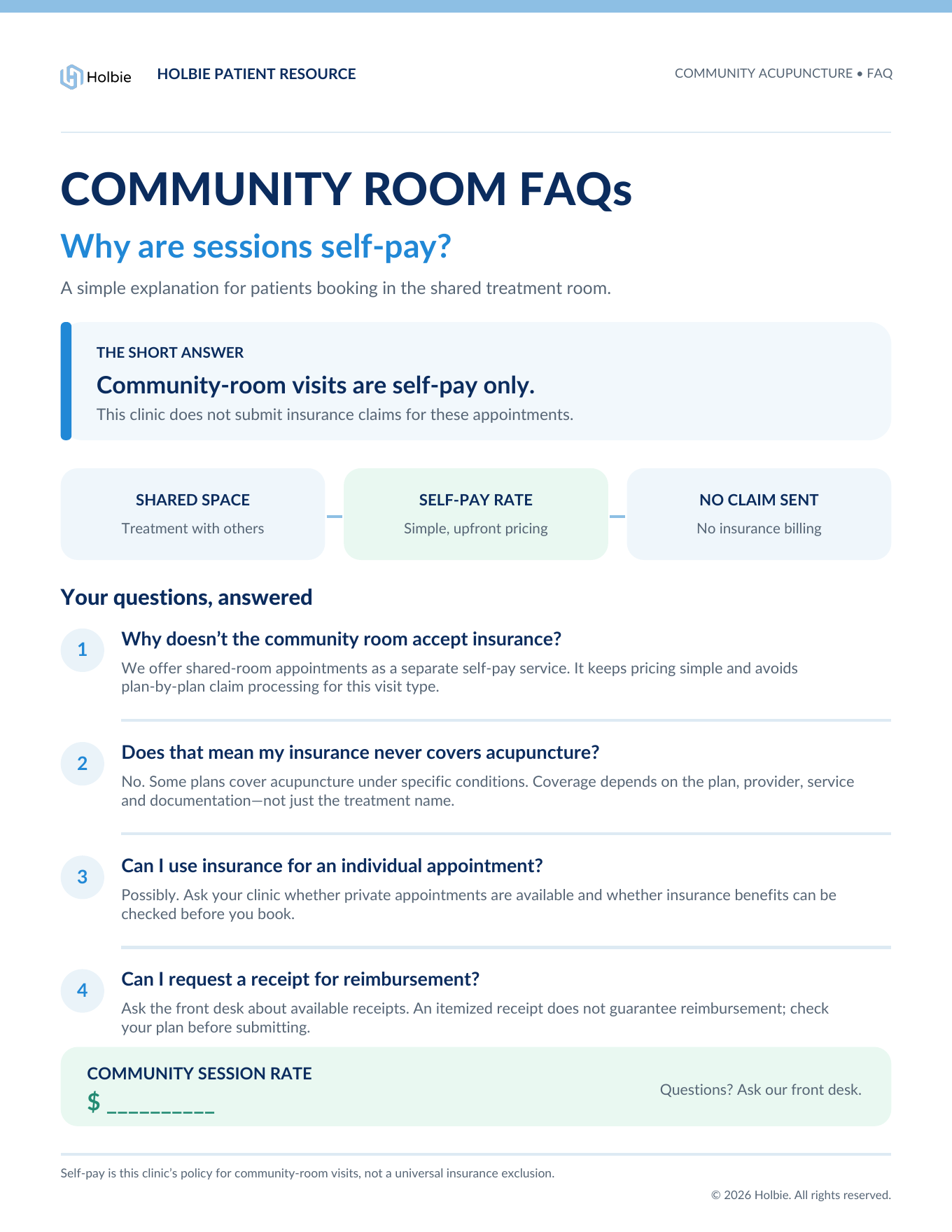
Free Download: Community Room Self-Pay FAQ
Want an easy way to explain this to patients? Print our one-page FAQ sheet, add your community session rate, and post it at your front desk or in your community room.
Keep Mixed-Model Practices Organized
Running both a community room and private insured rooms gets messy fast if your software can't keep them apart. Holbie was built for the realities of independent holistic clinics:
- Resource-based room scheduling: keep community chair bookings separate from private treatment rooms, so you never double-book equipment or tables.
- Time-tracking SOAP notes: record contact minutes as you go, so your private insurance claims stay accurate.
- Transparent pricing: scheduling, digital intake, and fast charting for $25 to $50 a month, with no costly add-ons. See what you could save.
- Full billing and denial recovery: we check your private-visit claims against payer rules before they go out, and our team fights delayed or underpaid claims.
Curious how much a few private, insured patients could add to your practice? Try our practice revenue calculator.
Next Steps for Your Clinic
- Update your community room FAQ (or download ours above) to explain that community sessions are self-pay only.
- Train your front desk to check insurance benefits whenever a community patient asks about their card.
- Hold a few private-room slots open each week for community patients who move to in-network care.
Looking to balance cash services and insurance claims without the admin hassle? Book a quick practice review with our team.