
If you entered healthcare because you harbored a secret, burning passion for complex governmental math equations, congratulations! You are a unicorn.
For the remaining 99.9% of us who got into practice to actually heal people—and who start sweating uncontrollably the moment insurance math enters the room—billing time-based codes can feel like an exercise in high-stakes puzzle solving.
Among the endless regulations designed to test our sanity, one rule reigns supreme over manual therapy billing: The CMS 8-Minute Rule.
Get it wrong on the low side, and you are literally leaving hard-earned revenue on the table. Get it wrong on the high side, and you invite terrifying post-payment audits and clawback demands that will have you reconsidering all your life choices.
Whether you are billing the VA, or commercial insurance, mastering this rule is non-negotiable. Here is your simple, human-translated guide to how the 8-Minute Rule works, how to calculate your units, and how to stop doing algebra at 9:00 PM on a Tuesday.
What Is the 8-Minute Rule?
The 8-Minute Rule is a calculation formula created by the Centers for Medicare & Medicaid Services (CMS). It explains how to convert direct, one-on-one treatment time into billable units for time-based CPT codes.
Before you start questioning your career path, it helps to understand the two main categories of codes:
- Service-Based (Untimed) Codes: You bill these as a single flat unit regardless of whether the procedure takes 5 minutes or 45 minutes. Examples include initial practice evaluations (CPT 97161–97163) or unattended hot/cold packs (CPT 97010).
- Time-Based (Timed) Codes: These are billed in 15-minute incremental units. This category includes Manual Therapy (CPT 97140), Therapeutic Exercise (CPT 97110), and Neuromuscular Re-education (CPT 97112).
The Core Rule: To bill a single 15-minute unit of a timed code, you must perform direct, skilled, one-on-one therapy for at least 8 minutes. If a service lasts 7 minutes or fewer, you cannot bill a unit for it on its own. Sorry, 7 minutes and 59 seconds does not cut it.
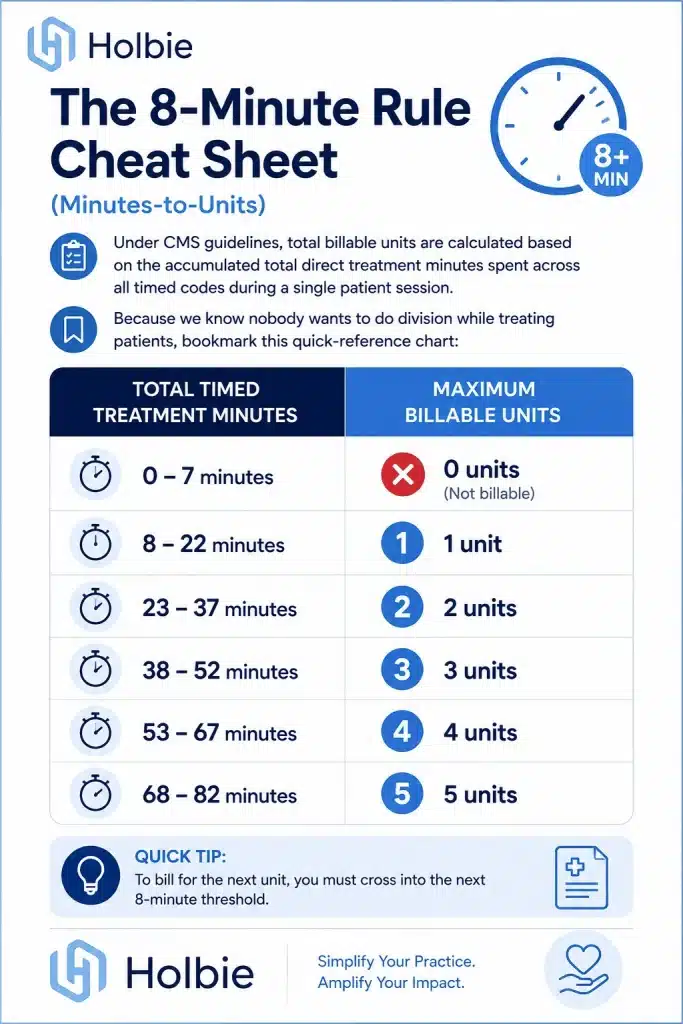
How to Calculate Units: A Real-World Example
Let's pretend a patient comes in for a 45-minute treatment session targeting chronic lower back pain. During that time, you perform:
- Manual Therapy (CPT 97140): 25 minutes
- Therapeutic Exercise (CPT 97110): 12 minutes
Here is how you figure out what you can actually bill without hurting your brain:
Step 1: Add Total Timed Minutes
25 minutes (97140) + 12 minutes (97110) = 37 total timed minutes
Step 2: Check the Cheat Sheet
Looking at our table, 37 total minutes falls neatly into the 23 to 37-minute range, which allows for 2 total billable units.
Step 3: Assign the Units
Since CPT 97140 took up 25 full minutes, you assign 1 unit to 97140 and 1 unit to 97110.
CMS 8-Minute Rule vs. Commercial "Rule of 8s"
Just when you think you've mastered the system, insurance carriers like to throw a curveball: Not all payers use the exact same calculation method.
- Medicare & CMS-Aligned Payers (The Cumulative Method): You add up all timed minutes first, calculate total allowed units from the total time, and then assign units across your codes.
- Commercial Insurers (The AMA "Rule of 8s"): Many commercial carriers evaluate each CPT code independently. Each individual code must cross the 8-minute threshold on its own—you can't pool leftover minutes together.
Failing to realize which rule a specific carrier uses is one of the fastest ways to land a claim on the rejection pile.
Common Pitfalls That Trigger Audits
- Counting "Fluff" Time: In-room chit-chat, undressing, table setup, or billing checkout time cannot be included in your timed CPT code minutes.
- Copy-Pasting Exact Times: Documenting "30 minutes of manual therapy" on every single patient chart across an entire month makes audit algorithms raise an eyebrow. Session times naturally vary slightly.
- Rounding Up Generously: Trying to turn 5 minutes of stretching and 4 minutes of manual therapy into a full billable unit. Audit algorithms catch this faster than a toddler reaching for a hot stove.
Stop Doing Math at Night: The Holbie Advantage
Look, we know we’re billing nerds, but even we don't want to spend our evenings calculating unit remainders on scrap paper. You went to school to deliver care, not to play math detective.
At Holbie, we do things differently. We aren't just an outsourced billing service; we are the nation's largest specialized platform built specifically for holistic and integrative health practices.
Because our software processes more holistic health claims than anyone else in the country, we see carrier quirks long before traditional billers do. We build those safeguards directly into your practice software:
- Audit-Tested SOAP Notes: Speed-optimized charting templates designed specifically for manual therapy and stress-tested against strict insurance audits.
- Automated Unit & Time Screening: Our platform flags minute-to-unit mismatches while you chart, stopping 8-minute rule rejections before claims are submitted.
- 100% Real-Time Transparency: Track every claim, authorization status, and payment in real time right from your live online dashboard—no "black box" secrets.
Ready to protect your revenue and leave the billing math to us?