If you run a massage therapy practice or an integrative health clinic, you’ve likely been asked this question dozens of times by patients entering retirement age: “Does Medicare cover my massage therapy?”
The short answer is no—Original Medicare (Part A and Part B) does not cover standalone massage therapy.
However, as integrative care becomes more mainstream, the line between cash services and Medicare coverage is shifting, especially when it comes to Medicare Advantage (Part C) plans and medically directed care.
Because Holbie processes the nation’s largest dataset of holistic health claims, we see how practices navigate this exact Medicare dilemma every day. Below is what practitioners and clinic owners need to know about Medicare’s stance on massage therapy in 2026, the critical exceptions, and how to turn Medicare inquiries into a profitable pillar of your practice.
The Hard Truth: Original Medicare Excludes Standalone Massage
Under current federal guidelines, Original Medicare (Parts A and B) explicitly excludes massage therapy when provided as a standalone treatment.
Medicare’s statutory exclusion applies regardless of whether the massage is:
- Prescribed by a primary care physician
- Deemed "medically necessary" for chronic pain or stress relief
- Performed by a Licensed Massage Therapist (LMT)
The core reason boils down to provider recognition. CMS (Centers for Medicare & Medicaid Services) does not currently recognize Licensed Massage Therapists as independent Medicare-eligible billing providers. Therefore, even if a physician writes a prescription for massage therapy, an LMT cannot enroll in Medicare or submit direct claims to Original Medicare for reimbursement.
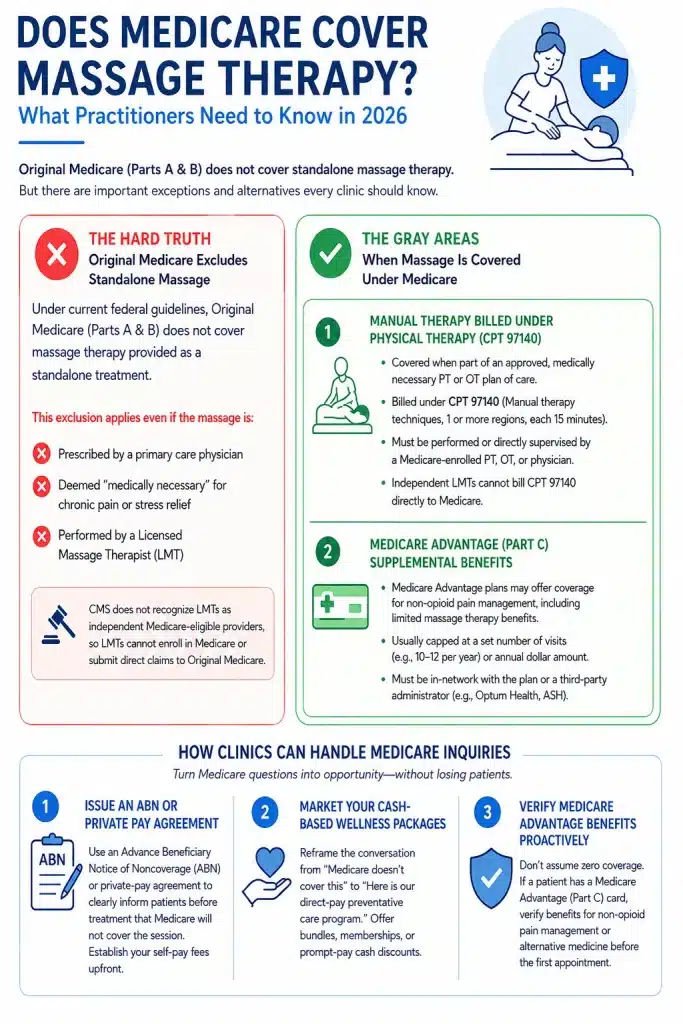
The Gray Areas: When Massage Is Covered Under Medicare
While direct, standalone massage therapy is excluded under Original Medicare, there are two distinct scenarios where patients can receive coverage for soft-tissue and manual therapies.
1. Manual Therapy Billed Under Physical Therapy (CPT 97140)
Original Medicare does cover manual therapy techniques when delivered as part of an approved, medically necessary Physical Therapy (PT) or Occupational Therapy (OT) plan of care.
How It Works:
A Medicare-enrolled Physical Therapist, Occupational Therapist, or Physiatrist performs or directly supervises soft-tissue mobilization, myofascial release, or joint mobilization.
The Billing Code
These services are billed under CPT 97140 (Manual therapy techniques, 1 or more regions, each 15 minutes).
The Catch for LMTs
An independent LMT cannot bill CPT 97140 directly to Medicare. For a clinic to bill this code, the service must be delivered by (or under the direct, in-person supervision of) a credentialed PT, OT, or physician who is actively enrolled as a Medicare provider.
2. Medicare Advantage (Part C) Supplemental Benefits
Unlike Original Medicare, Medicare Advantage plans (offered by private commercial carriers like Aetna, Humana, UnitedHealthcare, and BCBS) have the flexibility to offer expanded supplemental benefits.
The Evolution
In recent years, CMS expanded the definition of "primarily health-related" supplemental benefits. As a result, select Medicare Advantage plans now offer coverage for non-opioid pain management, including acupuncture, chiropractic care, and in some cases, limited massage therapy benefits.
How It Works
Coverage depends heavily on the specific regional plan and employer group. These benefits are usually capped at a strict number of visits per year (e.g., 10 to 12 sessions) or a annual dollar stipend.
Network Requirements
To bill a Medicare Advantage plan for massage, the LMT or clinic must typically be contracted directly with the Medicare Advantage plan’s specialty network (or through third-party benefit administrators like Optum Health or American Specialty Health).
How Clinics Can Handle Medicare Inquiries (Without Losing Patients)
When a Medicare patient learns their treatment isn't covered, it doesn't have to mean a lost booking. Here is how leading holistic practices use this transition to educate patients and protect cash flow:
1. Issue an ABN or Private Pay Agreement
If you run an integrative clinic with enrolled Medicare providers (or offer services that overlap with Medicare-eligible care), ensure your front desk utilizes an Advance Beneficiary Notice of Noncoverage (ABN) or a standard private-pay agreement. This clearly communicates to the patient before treatment that Medicare will not cover the session and establishes your self-pay fee structure upfront.
2. Market Your Cash-Based Wellness Packages
Patients on Medicare are often some of the most dedicated wellness consumers because they prioritize mobility and pain relief. Reframe the conversation from "Medicare doesn't cover this" to "Here is our direct-pay preventative care program." Offering packaged treatment bundles, automated monthly wellness memberships, or prompt-pay cash discounts keeps your front desk operations friction-free.
3. Verify Medicare Advantage Benefits Proactively
Never assume a patient's Medicare card means zero coverage. If a patient presents a Medicare Advantage (Part C) card, perform a rigorous benefit verification before their first appointment to check for non-opioid pain management or alternative medicine riders.
Eliminate the Insurance Confusion with Holbie
Whether you are navigating Medicare Advantage supplemental benefits, verifying commercial insurance riders, or structuring a cash-and-insurance hybrid practice, billing complexities shouldn't hold your practice back.
Holbie is the nation's premier billing platform for holistic care, pairing expert specialists with proactive software. We eliminate claim errors before they happen, track visit caps in real time, and provide acupuncture-tailored, audit-tested SOAP note templates to protect your practice.
Want to streamline your clinic's billing, verify patient benefits instantly, and grow your revenue with confidence?