Most acupuncturists and massage therapists didn’t open a clinic to fight with Availity, decode remittance advice, or sit on hold with insurance reps while patients wait in the lobby.
You got into this to treat patients. But if you take insurance, your billing workflow dictates whether your practice stays open or bleeds cash.
When billing runs smoothly, money lands in your bank account every two weeks like clockwork. When it fails, you get hit with a 20% denial rate, weeks of uncollected revenue, and charts piling up on your desk every Sunday night.
Whether you bill in-house or outsource, here is what actually happens to a claim from the moment a patient books to the day money hits your account—and where independent clinics lose revenue along the way.
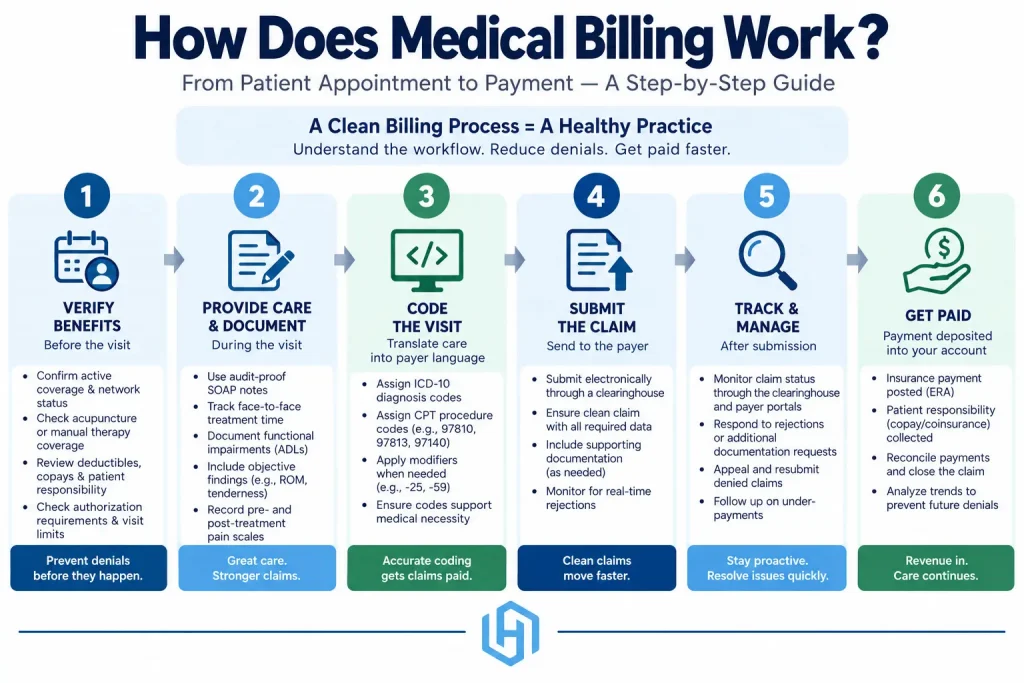
1. The Trap at Scheduling: Verification of Benefits (VOB)
A claim's fate is usually decided before the patient walks through your door. Roughly 70% of preventable denials happen right here.
Most solo clinics make one of two mistakes: they take a patient's card at face value, or they log into a basic portal that says "Active Coverage" without checking the fine print.
For holistic care, the fine print is everything:
- The Specialty Carve-Out: A policy might cover physical therapy but completely exclude acupuncture (97810/97813) or manual therapy (97140).
- Condition Limits: Many plans only cover acupuncture for specific ICD-10 codes, like chronic low back pain or nausea, and will flat-out deny neck pain or migraines.
- The Hidden Pre-Auth: If you treat a VA Community Care or Workers' Comp patient without an active authorization number on file, you won't get paid. Period.
How we approach it at Holbie: We don't rely on generic portal checks. We verify visit caps, holistic benefit riders, copays, and pre-auth requirements before treatment starts so providers aren't delivering care they can't collect on.
2. The Treatment Room: Documenting to Get Paid
Insurance carriers don't pay for your time; they pay for documented medical necessity. If an auditor pulls your chart six months from now, can you defend the units you billed?
To an auditor, "patient felt better after treatment" is worth zero dollars. They look for measurable, objective facts:
- Direct contact vs. rest time
- ADL deficits: You need to show how pain limits Activities of Daily Living—sitting at a desk, lifting groceries, or walking more than 15 minutes.
- Physical exam findings: Documenting muscle hypertonicity, localized tenderness, and weakness by specific side (Left, Right, Midline).
We built our SOAP templates inside Holbie specifically to capture these exact fields in seconds. You tap the screen to record functional deficits, pre/post pain scores, and face-to-face minutes, and the note is audit-ready before the patient leaves the room.
3. Translation: Diagnosis and Procedure Codes
Once the chart is signed, care gets translated into billing language:
- ICD-10 (Why you treated): Establishes medical necessity (e.g., M54.50 for low back pain).
- CPT (What you did): The procedures performed (e.g., manual acupuncture 97810, electroacupuncture 97813, manual therapy 97140).
- Modifiers: Flags exceptions. If you performed a distinct exam on an established patient with a new injury, you attach Modifier -25. If you performed manual therapy alongside acupuncture in a separate session/region, you need Modifier -59.
If you miss a modifier or pair a diagnosis code with the wrong CPT line, the clearinghouse or payer may drop the claim automatically.
4. The Gatekeeper: Clearinghouse Scrubbing
Your software bundles the visit data into an electronic CMS-1500 form and transmits it via an EDI 837P file to a clearinghouse.
Think of the clearinghouse as an airport security checkpoint. It checks for surface errors: valid NPI numbers, active policy IDs, matching birth dates, and taxonomy codes.
If there's a typo in the subscriber ID, the claim gets kicked back as a clearinghouse rejection. This is not a formal insurance denial; the insurer hasn't even seen it yet. It’s an administrative bounced check.
Because Holbie has billed holistic claims exclusively for over two decades, our platform screens claims against historical payer rules across states like California, Florida, and New York before transmission, catching specialty-specific coding issues standard clearinghouses miss.
5. Payer Adjudication: The Decision
Once the claim clears the gatekeeper, it lands with the payer (BCBS, Aetna, UnitedHealthcare, VA CCN, etc.). The carrier runs it through their automated adjudication engine.
Three outcomes occur:
- Paid: The claim passed every clinical edit and fee schedule rule. Payment is queued.
- Rejected: Basic subscriber or policy mismatch. Requires a quick administrative fix and resubmission.
- Denied: The carrier refuses to pay. They cite a Claim Adjustment Reason Code (CARC), such as timely filing passed, medical necessity not met, or non-covered service.
6. Posting the Remittance (EOB / ERA)
When payment arrives, it comes with an Electronic Remittance Advice (ERA) or paper Explanation of Benefits (EOB).
This details:
- The original charge.
- The contracted allowable rate.
- What the insurance company paid via EFT.
- The contractual write-off.
- The balance owed by the patient (deductible, coinsurance, copay).
Post every penny to the patient’s ledger in your practice management software. If your billing software doesn't sync cleanly with your schedule and ledger, patient balances slip through the cracks, leaving money sitting uncollected.
7. The Difference Maker: Denial Management
This is where solo clinics get crushed.
Across the country, solo practitioners who do their own billing average a 15% to 25% denial rate. Even non-specialized, general medical billers see 12% to 20% denials because they don't understand acupuncture unit limits or massage therapy rules. Chasing those unpaid claims takes hours of phone calls, formal appeals, and medical record tracking before the 90-day or 180-day timely filing clock runs out. Most solo owners simply run out of time and write the balance off.
A zero percent denial rate doesn't exist in healthcare; payer rules change constantly. But keeping denials in the low single digits is entirely achievable with proper front-end scrubbing.
And when an insurance carrier does push back, you shouldn't have to spend your evenings dealing with it. At Holbie, we back our software with a dedicated denial resolution team whose sole job is to track down unpaid claims, adjust codes, submit appeals, and recover revenue that belongs to your clinic.
Keep More of What You Earn
Medical billing shouldn't cost you your evenings or thousands of dollars in fragmented software subscriptions.
Holbie gives independent holistic practices an all-in-one platform—combining $25–$50/mo scheduling, compliant SOAP charting, and POS with dedicated, full-service billing and denial resolution.
Want to see where your billing workflow is leaking revenue?